When an English Football League team is relegated from League Two, they do not simply fall off a cliff. They enter the National League, the top of a vast, interconnected structure known as the National League System (NLS), or more commonly, the non-league pyramid. For volunteers, coaches and fans at the grassroots level, understanding this system is essential. It is the ladder your club climbs, or the structure that dictates your away days.
The pyramid is not just a list of leagues. It is a strict hierarchy, governed by the FA, which links thousands of grassroots clubs through promotion and relegation. But it is not just about winning football matches. Progression requires meeting stringent criteria off the pitch, too.
The National League System: Steps 1 to 6
The non-league pyramid officially starts below the English Football League (EFL). The EFL consists of the Championship, League One, and League Two. Below League Two sits the National League System, which is divided into six steps.
Step 1: The National League
The pinnacle of non-league football is the National League, consisting of 24 clubs. This is a fully national division and is heavily professionalised. Many clubs here are former Football League sides seeking a return, while others are ambitious outfits looking to break into the EFL for the first time. Two teams are promoted to League Two each season: the champions, and the winner of a playoff.
Step 2: National League North and South
Below the National League, the pyramid splits geographically into the National League North and the National League South, each with 24 teams. This regional split reduces travel times and costs for clubs, which is crucial as budgets shrink. Four teams in total (two from each division) are promoted to the National League each season.
Step 3: The Premier Divisions
At Step 3, the geography narrows further. There are four leagues at this level, each generally containing 22 teams:
- Northern Premier League Premier Division
- Southern League Premier Division Central
- Southern League Premier Division South
- Isthmian League Premier Division
These leagues cover specific swathes of the country, meaning clubs are playing opponents closer to home.
Steps 4, 5 and 6
The pyramid widens out as you move down. Step 4 consists of eight divisions, Step 5 has 16 divisions, and Step 6 features 17 divisions. These are the leagues where true grassroots football meets the semi-professional game. The leagues are highly localised: such as the North West Counties Football League, the Hellenic League, or the Combined Counties League.
Below Step 6, the NLS officially ends, and regional feeder leagues take over. However, promotion into Step 6 is still entirely possible for clubs that meet the requirements.
It Is Not Just About Points
The biggest hurdle for many grassroots clubs is not the opposition on the pitch, but the ground grading required by the FA. To move up the pyramid, a club's facilities must meet the standard for the division they are entering.
This means that winning a league does not guarantee promotion. If a Step 5 club wins their division but their ground does not meet the FA's Grade D requirements (which cover aspects like covered seating, floodlight lux levels, and dressing room sizes), they cannot be promoted.
For a club secretary or committee, ground grading is a constant, looming challenge. The step up from local football to the National League System requires significant financial investment in infrastructure, often before a ball is even kicked in the new division.
The Reality of Promotion
Climbing the steps is the dream for ambitious clubs, but the reality is harsh. The financial leap required to compete at higher levels is substantial. Player wages increase, travel costs mount, and the administrative burden on volunteers becomes heavier.
Yet, the pyramid remains the defining feature of English football. It ensures that a well-run local club in Step 6 has a theoretical route to the Football League. It is a system built on aspiration, governed by rules, and powered by the relentless effort of club volunteers.
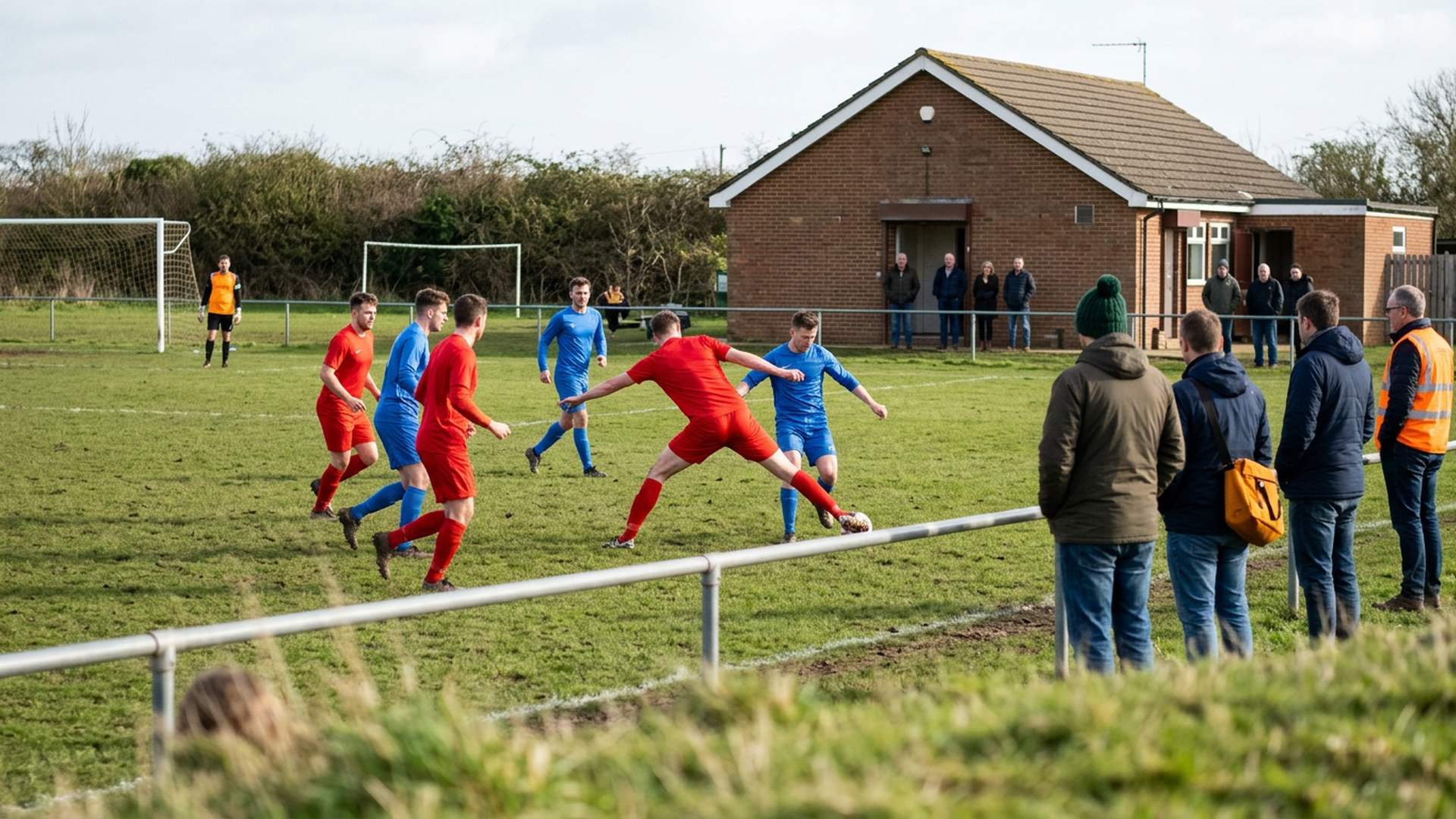
Next time you stand on a touchline at a Step 5 or 6 ground, remember: you are not just watching a local match. You are watching a team navigating the most complex, demanding football structure in the world.
To help fund your club's next ground grading improvement, check out playfundwin.com.
More from the LeaguePages blogPrefer the interactive version? Read this post in the app at leaguepages.com/blog/how-the-football-pyramid-works-the-steps-beyond-the-efl — with related reads, series navigation and saved posts.